Last of the Blue and Gray by Richard A. Serrano
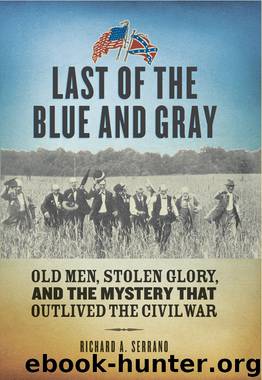
Author:Richard A. Serrano [Serrano, Richard A.]
Language: eng
Format: epub
ISBN: 978-1-58834-396-3
Publisher: Smithsonian
Published: 2013-10-07T16:00:00+00:00
Albert Woolson, the last in blue in the twilight of his old age, still could hit the drums like a boy sounding the march to war. (Courtesy of Whitman College and Northwest Archives, Walla Walla, Washington)
The old Yankee came home from the parade and disappeared through the front door. He did not have much to say. “Feeling as good as always,” was about all he managed.
But he could not escape the press of the crowds. In August the Sons of Union Veterans of the Civil War honored his war service, and Woolson sent them his thanks. “As the last survivor of the Union Army, I have seen these United States grow into the greatest nation in the history of man,” he told them. “Our sacrifices were not in vain.”
The Sons displayed a new bust of the old man at a ceremony at the Hotel Duluth. The governor and the mayor were on hand in the hotel ballroom, and a chorus of nurses from St. Luke’s Hospital entertained the 600 guests. Prominent among them was Maj. Gen. Ulysses S. Grant III.
Woolson dressed smartly in his double-breasted GAR jacket and cap. Holding firmly onto his cane, he stood between the mayor and the major general and watched as his young granddaughter Frances Ann unveiled the bust that soon would be on permanent exhibit at the city hall. The GAR motto was etched into its base, words first heard during the Gettysburg campaign: “To the Last Man.”
“It’s a good likeness,” Woolson said. He thanked the sculptor, Avard Fairbanks of Salt Lake City, whose works had included Abraham Lincoln and four sculptures in the Capitol building in Washington. “We are all here for a grand purpose,” Woolson said. “Thank you for this splendid assembly.”
Gov. C. Elmer Anderson proclaimed that Minnesota was “proud of Albert Woolson, one of the few men who remembers that terrible struggle” of almost a century ago. “In fighting to preserve this nation, the men of the Union forces made one of the greatest contributions in the history of this country, as well in the history of western civilization.”
Major General Grant read greetings from Vice President Richard Nixon. Gen. Douglas MacArthur wired that the “tradition that Woolson represents is perhaps the finest in the history of the republic.” (Woolson had sent MacArthur a birthday greeting a month earlier, in January, and MacArthur, in thanking the Yankee veteran, twice misspelled his name as “Wootson.”)
Fairbanks spoke too; he had just been commissioned for another sculpture of Woolson, this one to be a life-size work commemorating both Woolson and the legacy of the Grand Army of the Republic. It was to be placed at Gettysburg, the watershed spot in the war.
Woolson did not hear the speeches or tributes. By this time he was almost completely deaf. Even at his home that morning, his daughter had to write a note in large block letters telling him that Major General Grant was at the door to pay a short visit. Woolson read the note and then looked up sharply.
Download
This site does not store any files on its server. We only index and link to content provided by other sites. Please contact the content providers to delete copyright contents if any and email us, we'll remove relevant links or contents immediately.
| Africa | Asia |
| Canadian | Europe |
| Holocaust | Latin America |
| Middle East | United States |
Fanny Burney by Claire Harman(26602)
Empire of the Sikhs by Patwant Singh(23084)
Out of India by Michael Foss(16853)
Leonardo da Vinci by Walter Isaacson(13336)
Small Great Things by Jodi Picoult(7140)
The Six Wives Of Henry VIII (WOMEN IN HISTORY) by Fraser Antonia(5515)
The Wind in My Hair by Masih Alinejad(5095)
A Higher Loyalty: Truth, Lies, and Leadership by James Comey(4960)
The Crown by Robert Lacey(4814)
The Lonely City by Olivia Laing(4801)
Millionaire: The Philanderer, Gambler, and Duelist Who Invented Modern Finance by Janet Gleeson(4478)
The Iron Duke by The Iron Duke(4354)
Papillon (English) by Henri Charrière(4274)
Sticky Fingers by Joe Hagan(4198)
Joan of Arc by Mary Gordon(4109)
Alive: The Story of the Andes Survivors by Piers Paul Read(4031)
Stalin by Stephen Kotkin(3965)
Aleister Crowley: The Biography by Tobias Churton(3640)
Ants Among Elephants by Sujatha Gidla(3467)
